
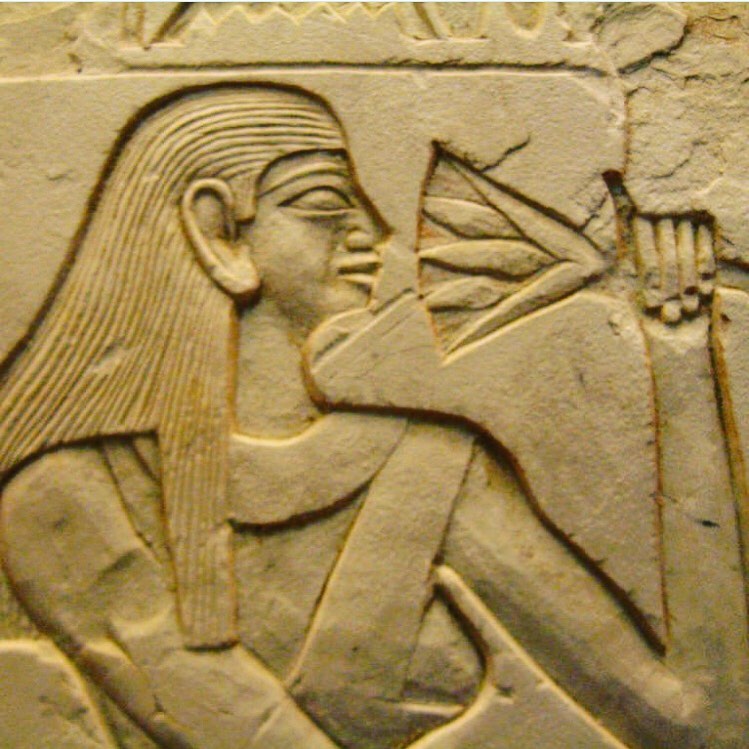
 PERFUME IN ANCIENT EGYPT NEFERTUM, God of Perfumers and Aromatherapists by Creezy Courtoy Nefertum (Nefertem, Nefertemu) was an ancient god, the God of Perfumers and Aromatherapists ( at this time perfumers were all aromatherapists ) mentioned in the Pyramid Texts (c. 2350 BC), but became more prominent during the New Kingdom (1539 - c. 1075 BC) and later. Nefertum was the son of Ptah and Sekhmet. Ptah, his father, was the creator God and the Patron of artisans. His mother, Sekhmet, was the Goddess with a dragon head who protected Egypt from its enemies but she was also the Goddess of plants and herbs and the Patron of medical and alchemist distillation. Nefertum ruled over ointments and perfumed oils. In Ancient Egypt, fragrances were considered as the essence of materialization of all things. Nefertum was thus considered the spirit of life. He represented beauty in its perfection and was associated with purification and youthfulness. His symbol and representation was the blue lotus flower, the sacred flower of Egypt through which the sun rose. Nefertum was the god of the lotus blossom who emerged from the primeaval waters at the beginning of time, and a god of perfume and aromatherapy. Nefertum was the god of healing, medicine and beauty and strongly associated with the lotus and often depicted in Egyptian art with a large lotus blossom forming his crown. The lotus was the only flowering plant in Egypt that bloomed nonstop throughout the year. Held by gods and goddesses near the nose of royal kings, queens and pharaohs as its scent, this flower was believed to be restorative and protective. 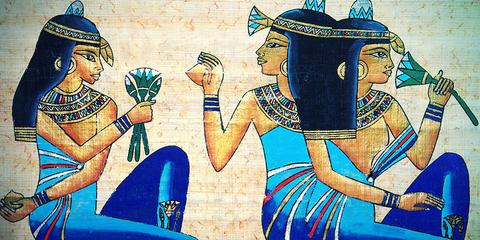 Nefertum was seen as the sun god and the grandson of the sun god. He was not originally worshipped in temples, but was an important aspect of the sun god, who was later discovered as the grandson of the sun god. For the people in Egypt, he was their protector and their healer. Nefertum was linked both to the pleasant scent of the lotus flower and to its medical properties which were well known to the ancient Egyptians. He was also associated with a number of the Egyptians favorite flowers, such as rose, geranium and cornflower. In fact, he could be described as the archetypal aromatherapist. According to one legend, he brought a bouquet of beautiful lotuses to the aging Ra to ease his suffering. As a result, he was described in the Pyramid Texts as "the lotus blossom which is before the nose of Ra". He may have originally been considered to be an aspect of Atum. According to one version of the creation story of the Ennead in Heliopolis, Nefertum (translated as beautiful Atum, or perfect Atum) was born from a blue lotus bud which emerged from the waters of Nun at the beginning of creation. Atum represented the sun and so Nefertum represented the sunrise. He cried because he was alone and his tears created humanity. It was thought that he was born with every sunrise, matured into Atum during the day before passing into the world of the dead every sunset. The cycle of birth in the morning and death every evening (as the sun travelled through the underworld) represented the daily struggle between Chaos and Order (Ma´at). When Atum was absorbed by Ra (Atum-Ra), Nefertum came to be considered as a seperate deity, still closely associated with the newborn sun. Then Ptah was promoted to the chief national god and proclaimed the ultimate creator, and Nefertum was described as his son by either Sekhmet or Bast (both "Daughters of Ra"). However, as the son of Ptah, he also became patron of the perfume and healing arts derived from flowers. Thus, Nefertum was seen as both an aspect of the sun god, and also his grandson. He was also linked to rebirth, both as a personification of the newborn sun and as the patron of many of the necessary ingredients of the mummification process. A passage of the Book of the Dead says the blessed dead will "Rise like Nefertum from the lotus, to the nostrils of Ra, and come forth upon the horizon each day". The Egyptian pantheon is particularly huge and fluid, with a wide variety of deities entering and exiting each other's myths. Nefertum used to be depicted as a beautiful young man wearing a lotus headdress, sometimes standing on the back of a lion. Occasionally he wears a headdress with two feathers and two necklace weights that were fertility symbols associated with Hathor (who in turn was closely associated with the two goddesses described as his mother, Sekhmet and Bast). He was sometimes depicted as a man with the head of a lion or as a reclining lion or cat. In this form, he was associated with the lion god Maahes, who may have been his brother, but may also have been an aspect of Nefertum. Like the newborn sun, he was generally depicted as a beautiful baby sitting on a lotus bud. Sometimes his body was shown wrapped like a mummy, with his arms and face unbound. He also had a lion or cat shape, attributed to his mother. He was also depicted as a human head emerging from a large water lily. 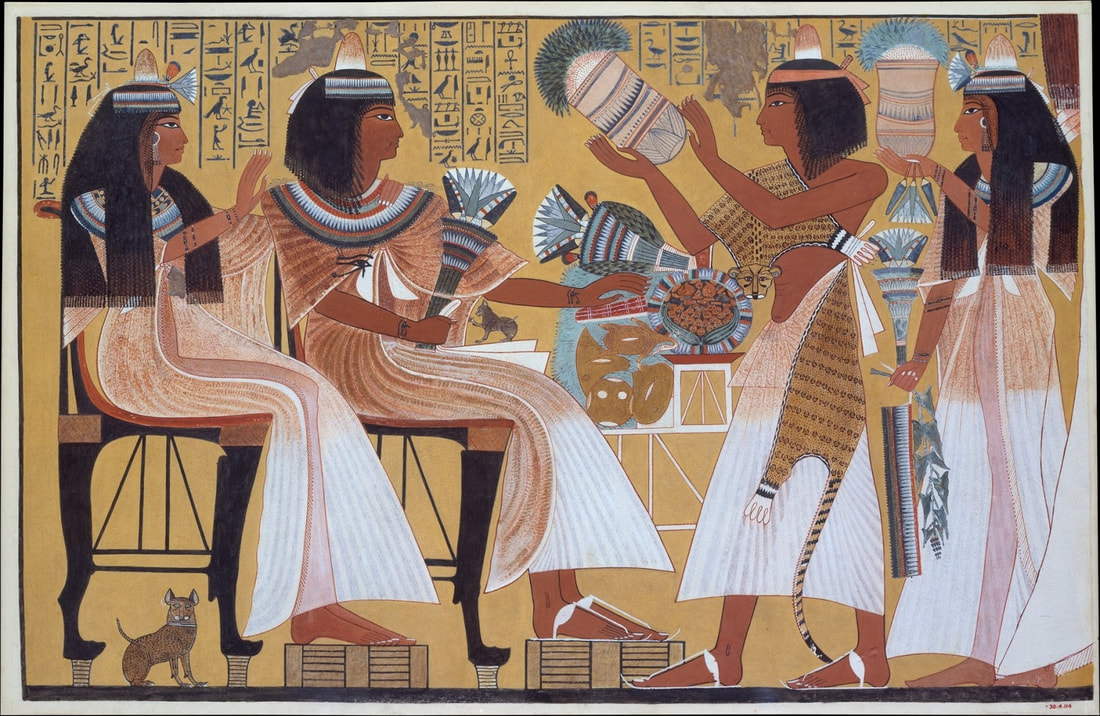 For the ancient Egyptians, however, with their holistic understanding of the universe, fragrances and perfumes were not only beautiful, but were also spiritual and therapeutic. The Blue Lotus The lotus flower flourishes on the banks of the Nile. It opens its large petals with the rising of the sun. To the ancient Egyptians it represented the sun because it banished darkness. Blue Lotus played a unique and important role in Ancient Egyptian culture. The plant was widely popular for its mood enhancing and mild psychedelic properties. Used both recreational and for spiritual effects, they often made a concoction out of Blue Lotus and wine.
This flower has even been placed alongside the deceased in ancient tombs. The plant is often depicted on walls and paintings as well, often depicted together with wine. The Blue Lotus was even the symbol for the union of Upper and Lower Egypt. Commonly used in art as a symbol of Upper Egypt. It was often shown with its long stems intertwined with papyrus reeds (a symbol of Lower Egypt) as a representation of the unification of the two lands. For the Ancient Egyptians, The Blue Lotus represented how the sky greeted the sun. Just as the sun rises above the horizon to start the day, the flower opens in the morning. Then just when the sun is setting, the flower closes itself at dusk. And because of this, the Egyptians coined the Blue Lotus the sacred flower of the sun and sun gods. As this symbol means also the creation and rebirth, the lotus is a fixed part of tomb and coffin decoration, often in combination with the scarab, which has similar symbolic meaning. If you want to learn more about national flowers visit my blog powerfulflower.blogspot.com
2 Comments
|
Archives
June 2024
Categories
All
|
 RSS Feed