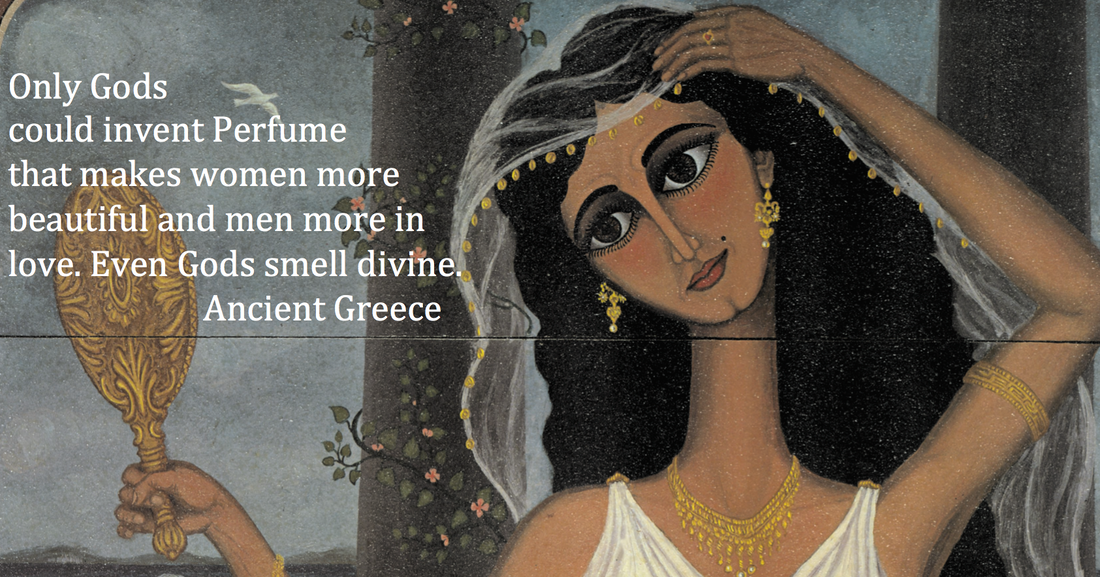
 Helene of Troy, Painting on wood, Creezy Courtoy's Collection By Creezy Courtoy, Perfume Historian and Anthropologist For a long time, Perfume remained an important source of revenue for Greece. In the Bronze Age, Egypt, due to its geographical, protected and isolated location and by its geological wealth and cultures, was obliged to import raw materials from Arabia and the Aegean Islands. Egypt was rich in gold, but did not possess the raw materials necessary for making perfumes. Arabs, Hadramaout (South Yemen) and Dhofar (Oman) provided Egypt with scented woods and resins (myrrh, incense, olebanon) and Greeks provided flowers, herbs and their talents of perfumers in the confection of perfumed oils. Greece was then a country of farmers, breeders, Artisan Corporations and a fighting aristocracy. Greece was a country of scents, herbs, flowers and plants. Due to its geographical location and its numerous surrounding islands, Greece was a gateway to Asia Minor, Syria and Egypt. The Greeks are credited for having added to spices, to gums and to balms, oils scented with flowers. Flowers and plants used for export had to be preserved and transformed. Olive oil, one of the main resources of Greece, was used as an ointment and as an excipient or absorbent in perfume oils. The Greeks practiced ‘enfleurage’ and from an early age, the art of creating perfumed oils. In the time of Ancient Egypt, perfume was used mainly to communicate with the gods; during Ancient Greece, it was used to resemble the gods. Perfume was actually used by Egyptians but never throughout history could Egyptians, impregnated with fragrant scents, assist human divination, not only in the sculptural art that gave the gods their human faces and bodies, but also in the wearing of perfume that participated in this quest of perfection by making humans more divine. Since gods smell good, to be like them you must smell divinely good. The Greeks associate perfume to the erotic power of the union of two people. The Greeks buried their dead with their possessions and a terracotta vase or alabaster containing perfume. For poor people, vials painted onto the coffin replaced the alabasters. The perfume played the role of intermediary between the world of people and that of Gods and helped the dead to reach the other world. In everyday life, perfume was not a neutral thing, « thion », « myron » or a simple aroma but a feminine being. It was used in and for everything; as a life elixir, a nectar, and a ragweed. It gave hope of immortality to humans because the Gods were beautiful and immortal. For the author Virgil, Venus (Aphrodite) created the rose perfume. "One day, Venus wanted to cut a white flower and pricked herself, covering her with an everlasting purple color. To Cupid, the rose seemed so beautiful that he kissed it… This is where its smell comes from." Towards the end of the II Millennium BC, the Greek industry acquired knowledge, “art de vivre” and know-how that gave birth to the Europe of Perfumes. Pliny the Elder, in his Natural History text (XIII 9-12 XV, 28-38), mentioned at least 22 kinds of perfumed oils, most of them extracted from plants naturally growing on the island of Crete: cypress, marjoram, broom, iris, spikenard, rose, myrtle, laurel, crocus, lily, juniper, pine, nut, almond, carnation, poppy, coriander, aniseed, cumin, narcissus, and daisy. During the period of the Mycenaeans, even taxes were paid in plants. Circa 1450 BC, perfumery was truly an industry controlled by the Masters of the Mycenaean palaces. The decryption of linear writing par par Alice Kober in 1947 and Michaël Ventris et John Chadwick in 1952, found on 20% of the 7000 Mycenaean clay tablets of the islands of the Aegean Sea show that a prominent position was given to scented products, ointments, incenses, aromatic wine, perfume oils, and spices. Everything listed on these tablets provided a real accounting of orders and exports. Perfumery, in Greece was mainly a branch of medical science. Some odors excited or inspired while others healed. Hippocrates studied skincare in a comprehensive manner and advocated perfumed baths and massages combined with the use of aromatic substances to treat some diseases. He recommended remedies based on sage, cinnamon or cumin, applied either through fumigation, potions, frictions or aromatic baths. He also used perfume as a protection against diseases. It is said that he saved Athens from the plague by burning aromatic woods and hanging flower garlands in the streets. Hippocrates considered various oils used to preserve odors, the use of flowers and spices and the choice of a hundred perfumes for different states of mind and health both for men and women. "Because both senses – taste and smell – are linked one to another, each serves somehow the pleasure of the other and man can thus discover fragrances either because it pleases the taste or the sense of smell.’’ Théophraste (400BC Book of Odors – Chapter III)  Oenochoes and ariballoi, Creezy Courtoy's Collection The Greeks were the first to utilize ‘’packaging’’ and ‘’marketing techniques’’. The alabasters, the oenochoes and the ariballoi were all made of terracotta decorated with trendy themes, perfectly understood by all the populations of the Mediterranean and all refer to Greek mythology or to major known themes. These vials were presented in various sizes in the same way as bottles are today: from the small inexpensive ariballoi vial containing little perfume to the enormous and expensive ariballoi jar which would today correspond to 1 litre of perfume. For a long time, perfumery items remained an important source of revenues for Greece. Cargos of wax-sealed vials and vases containing perfume oils were continuously leaving Peloponnese or Crete towards Mediterranean ports. Masters in the Art of creating perfumes; Masters in the Art of Cosmetics, ornament and make-up; Masters of the Art of packaging: the Greeks created the first industry of perfumery during Ancient times. If you want to learn more about the Anthropology and History of Greece or any other countries, enrol for Creezy Courtoy's Courses or Master Classes
0 Comments
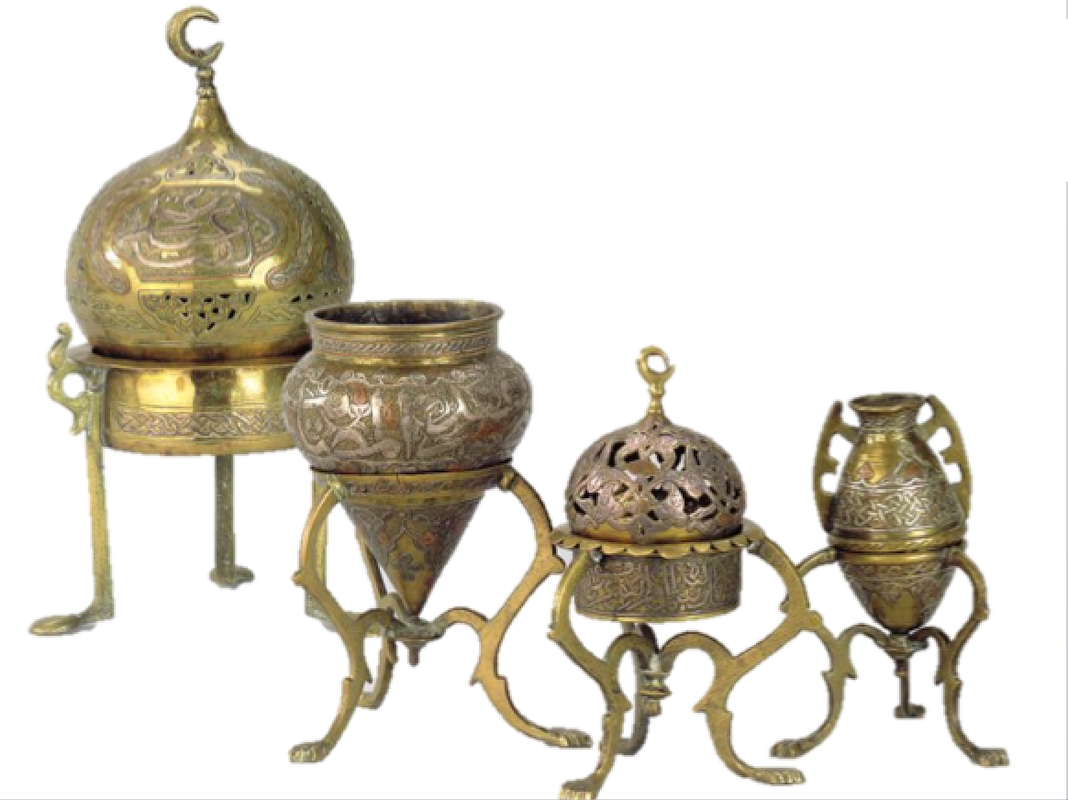 Copyright Creezy Courtoy Collection By Creezy Courtoy, World Perfume Historian and Anthropologist My first passion has always been the impressive history of perfume and I could never think the way I think today if I did not spend all my life collecting perfume antique artworks and searching for the true perfume history. When you start searching, it never ends and still today I am looking for something; each piece leading me to more research. In the Arab World, perfume was precious, it was considered as pure gold. Let me invite you to follow me on the history of perfume in that part of the world. Circa 4000 B.C., the Sumerians built the first City States such as Sumer, Ur, Uruk or Nippur, along rivers. “Mesopotamia” literally means “the country between the two rivers”. Located between Tiger and Euphrates, this region currently corresponds to Iraq, Syria, Lebanon, Southern Turkey and Israel. Cuneiform writing carved onto the clay tablets reveals formulas and perfumes used by these ancient populations since the middle of the third millennium B.C. Lebanese cedar, cypress and myrtle were the three most used fragrances. Originally, the gods loved natural perfume and got close to those who wore them. This is why the servants of the temple covered their bodies with myrtle oils before carrying out the rituals and the offerings to the numerous gods. Perfumes were reserved to divinities, kings and temple worship. Gilgamesh, King of Uruk, lived a rather eventful life, characterized by his vain quest for immortality. Perfume, the most noble and precious element then made its way into his alchemy research. The relation between medicine and gods was very close. One of the healing gods was the two-headed snake Ningishzida. The snake, symbol of eternal life, might have been the first icon of caducei. His name in Sumerian is translated as “lord of the good tree”. 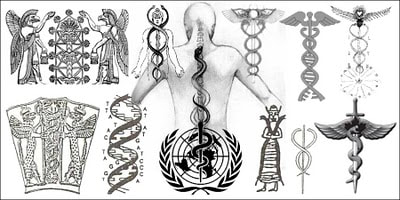 About 1000 years later, the Akkadians replaced the Sumerians and created the first empire of the world ruled by Sargo the Ancient.
Phoenicians sailors and traders settled on the coast of Lebanon and build colonies in Cyprus, Crete, sicilia, malta and Northern Africa. Tyr, their capital, having enjoyed a permanent relation with Egypt and Mesopotamia, became one of the most important ports. Circa 1900 B.C., Babylonians replaced Akkadians. Hammurabi (1792-1750 B.C.), created the powerful empire of Babylon. Babylon remained the main warehouse of spices from all over the world for a long time. It received spices from India and from the Persian Gulf, scented gums from Arabia and balms from Judea. Nabuchodonosor I (1124 B.C.) had his palace built with cedar beams and cypress doors that smelled kilometers away. According to Herodotus, over 1000 talents of pure incense were burnt every year on the altar of Belus. Zoroaster prescribed the use of perfumes on altars five times a day. In the hanging Gardens of Babylon, one of the seven wonders of the Ancient World, all the scented plants were showcased. According to Diodorus, (Greek columnist of the 1st century, contemporary of Julius Caesar) cedar, mimosa, Arabian jasmine, lily, crocus, iris, violet and rose, gave the Kingdom the reputation of owning the most beautiful roses of the Ancient Orient. Chaldeans, circa 600 B.C., represented the last civilization of Mesopotamia with two famous Kings: Nabopolassar and Nabuchodonosor II. They inherited a great culture, developed astronomy, astrology and added all this science to the Art of Perfumery. Plants and resins must be collected at certain times in the day, or at a precise moment in the year in order to reinforce their efficiency. The fall of Babylon, conquered by the Persians in 539, did not upset the trade of perfumes. Focused on the fringes of the desert, the caravan kingdoms owed an important part of their prosperity to the trade of perfumes. Sidon (then Carthage) replaced Babylon as the capital of perfume and spices. For the Cananeans as well as for Babylonians, Phoenicians and Sabaeans, perfumes and spices were both pure gold and divine message. For thousands of years, they carefully preserved the trade and even caused wars. Arabia Felix, also called the “Fertile Crescent”, stretched from Oman to the Suez Gulf and across its length were paths taken by the caravans. Called “The Perfume Roads”, these ancient trails linked the south to the North of this continent and crossed the deserts of one of the oldest countries in the world. To ensure the security of the trade on The Perfume Roads, in the 10th century B.C., Balkis, the Queen of Sheba organized a meeting with Solomon, the Hebrew King... If, like me, you are impassioned by World Perfume History, I will be happy to transmit my knowledge to you and tell you more about the Perfume History in the Arab World. We definitely need more perfume history teachers to make sure the perfume heritage will be preserved and transmitted to the next generations. |
Archives
June 2024
Categories
All
|
 RSS Feed